Grand River Community Play
Voice of the River
The Grand River Community Play Project grew along the river from 2022 to 2025. Through every season, indoors and out, people gathered to share stories, make art and bring Voice of the River to life.
A riverwide project, made together
- 310 km of Grand River
- Thousands of actors, audience members and creators
- More than 45 supporting partners
- 250 volunteers

The Grand Tour
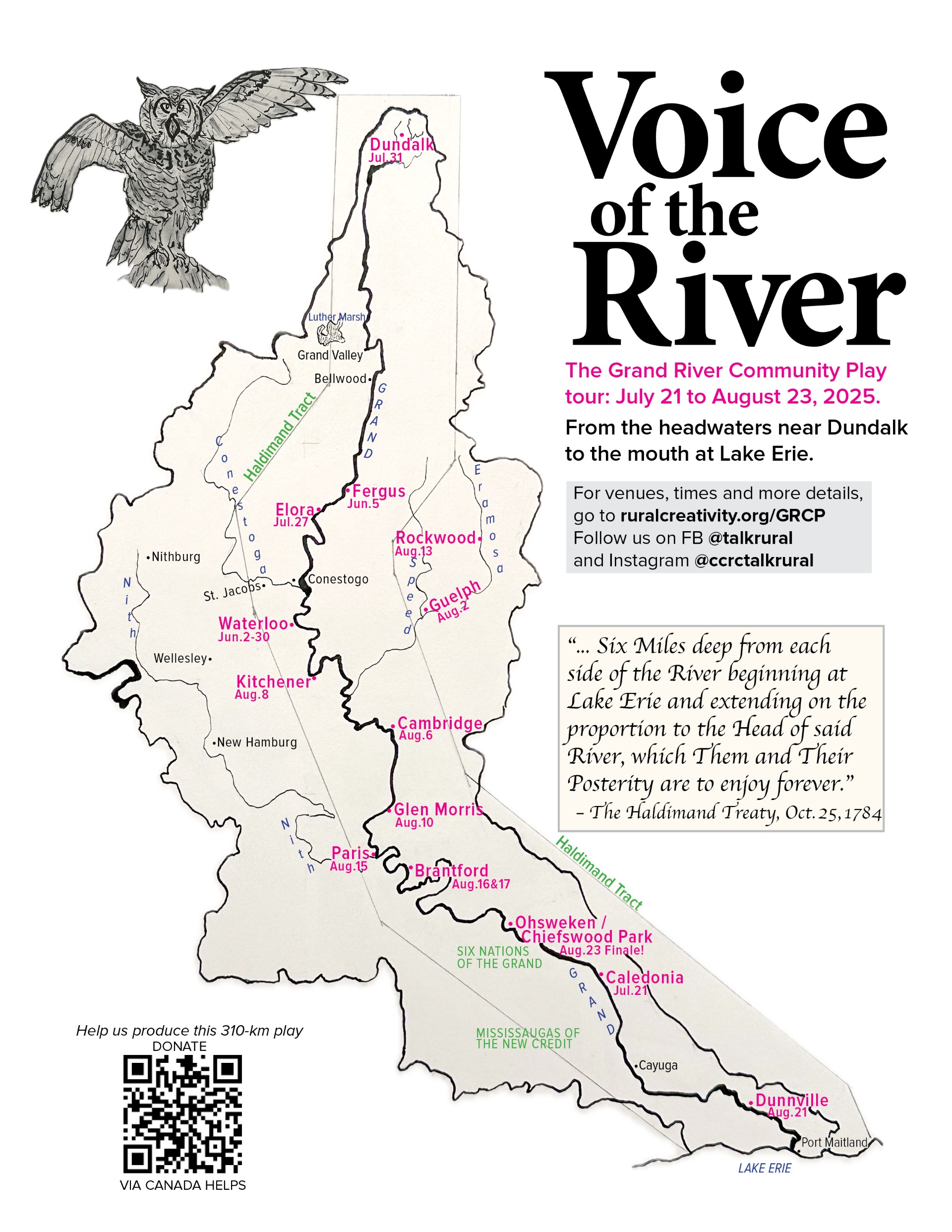
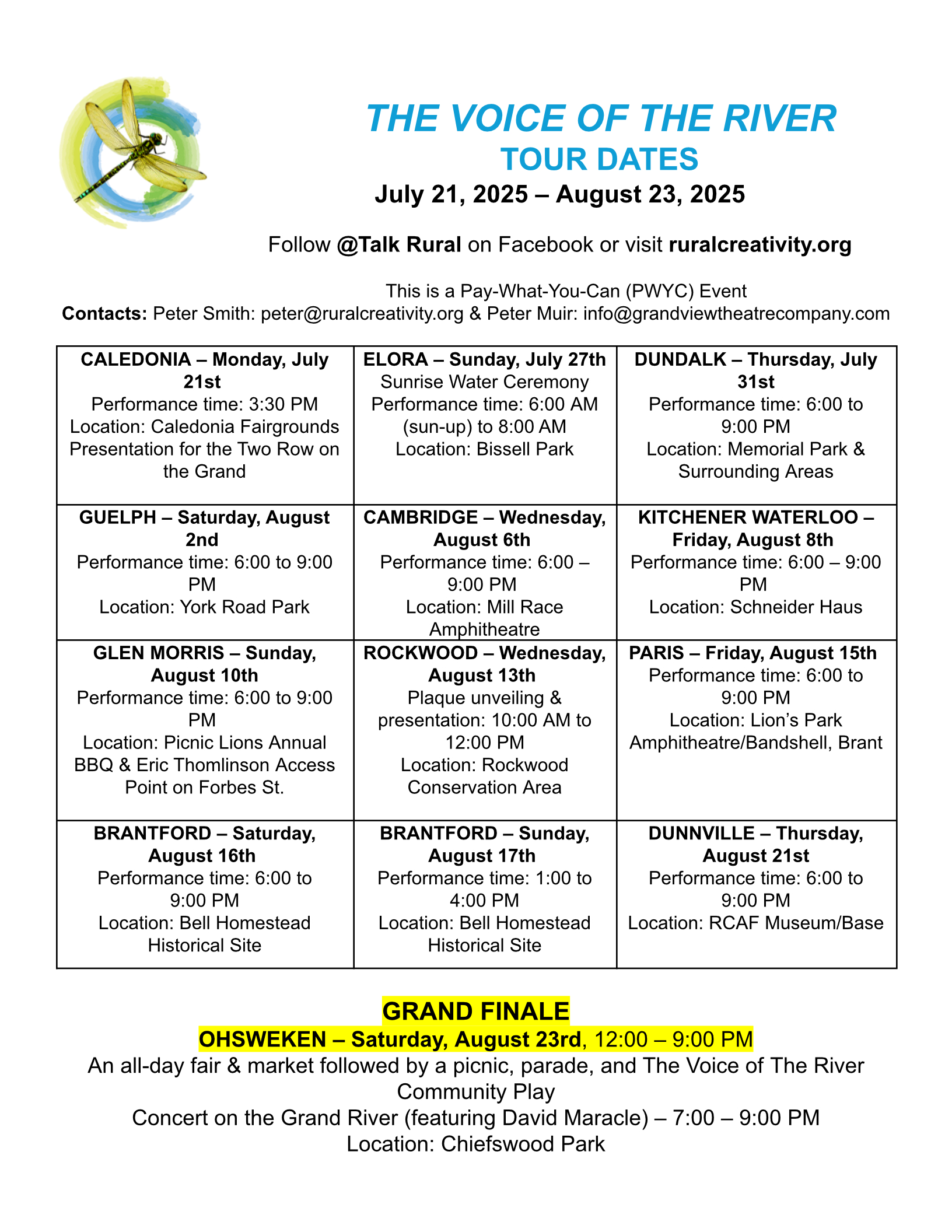
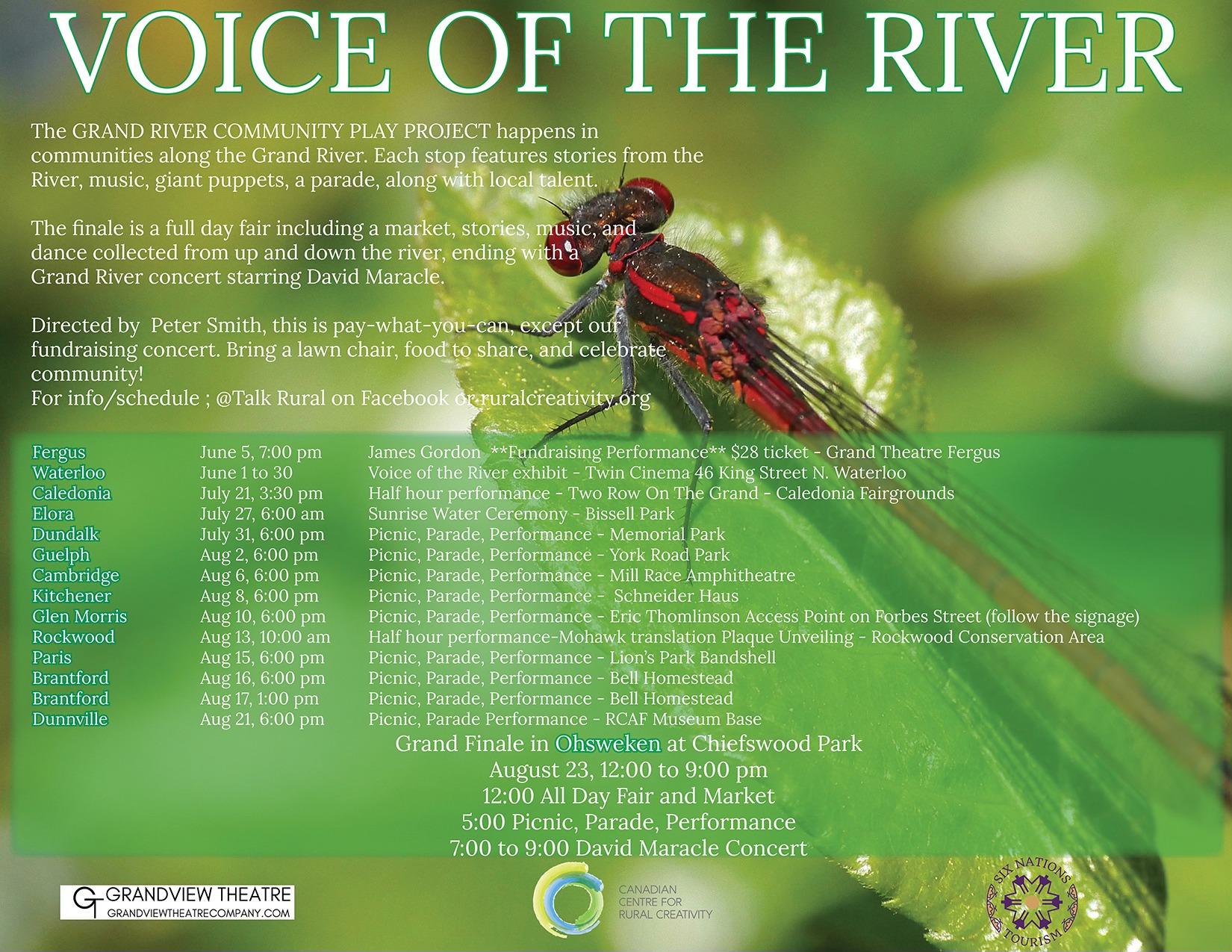
For four weeks from mid-July to August 2025, The Grand Tour: Picnic, Parade & Play travelled along the river. The journey culminated on August 23 with the Voice of the River Grand Finale at Chiefswood Park on Six Nations of the Grand River.
Art along the way
Three exhibitions shared work from the project:
- Blyth Festival Art Gallery, October 2024
- Grand River Quilt at WEFFest in St. Jacobs, 2025
- Odeon Art Gallery at Princess Cinemas in Waterloo, June 2025
The Grand River Quilt Project brought together approximately 70 squares and their accompanying stories, created by people who live along the Grand. The quilt travelled with The Grand Tour and continues its journey to communities along the river in spring and summer 2026.
Thank you for being part of the story
Voice of the River began at the Grand River’s headwaters and travelled across the watershed to Lake Erie. Over three years, people welcomed us into their communities for workshops, story circles, performances and conversations.
You shared stories, listened with care, sang, created and helped us through the challenges along the way. Whether you joined us once or travelled with the project for years, you helped make this celebration of the river and its communities possible. We are deeply grateful.
The story continues as the Grand River Quilt visits communities along the waterway, accompanied by music and stories. Watch the Grandview Theatre and Canadian Centre for Rural Creativity websites for updates.
Thank you for the journey of a lifetime.
The Voice of the River
The Grand River Community Play project took place in July and August, 2025!
A community play that connects the communities and inhabitants that live along the length of the Grand River – a river that starts in the highlands of Dufferin County, and travels 310 km, before emptying into Lake Erie at Port Maitland.
About a million people live within the watershed, a watershed that passes cities, towns and villages, trees, wild grasses and coyotes, and includes thirty-nine municipalities and two First Nations territories.
Explore the Project
2025 Tour Resources
Stories & Collections
All Are Welcome
The 2025 performances were pay-what-you-can, with free attendance welcome. If you would like to continue supporting the production, you can make a donation.
A Celebration of Community
2025 was the year we celebrated community in a unique and transformative way. We brought people together from along the Grand River and across her watershed to tell stories, sing songs, learn and share about their home, and fall in love all over again.
The plan for August of that year was for The Voice of the River: The Grand River Community Play to start at the headwaters of the Grand in Dundalk and work its way down the river to its mouth at Lake Erie, stopping in natural settings, villages and towns along the way.
This was an all-inclusive event — anyone could participate in whatever manner they felt comfortable. In the months leading up to August, the plan was to visit the communities where the production would be presented for story circles and workshops in everything from building unique, large community puppets and making costumes to stitching storytelling quilt squares, building set pieces and making props. Some participants might even have learned stilt walking, alongside all manner of acting and singing, with plenty of Grand River storytelling.
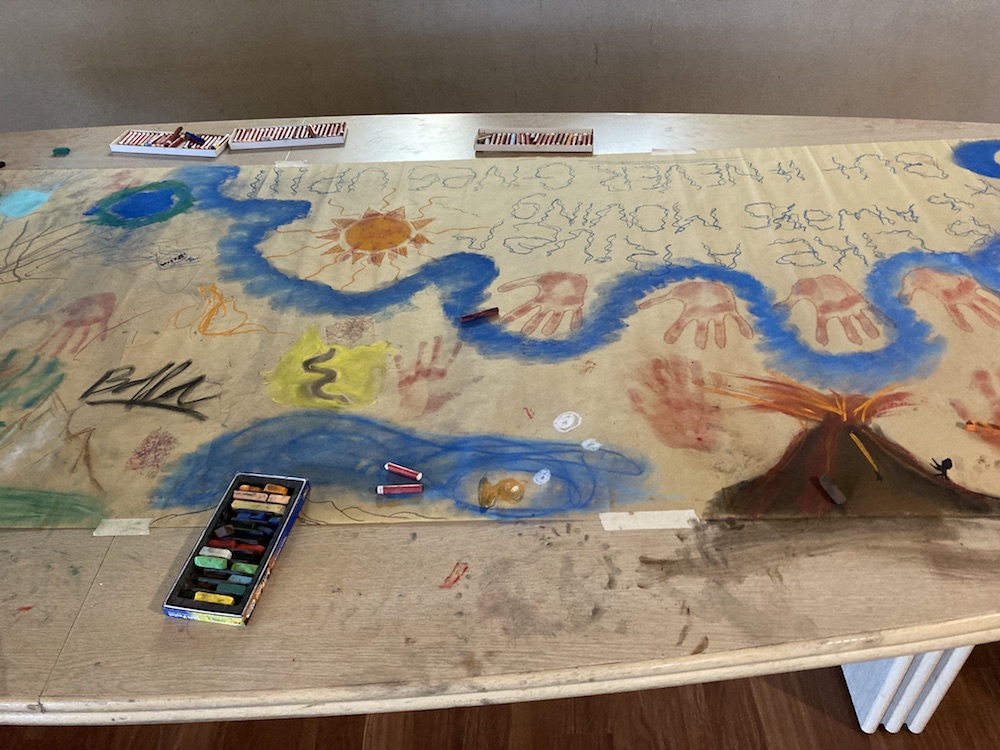
This image was created at a Voice of the River workshop held at Six Nations Polytechnic in the spring of 2024 — a work in progress with many hands participating.
Each presentation of The Voice of the River was intended to be unique to its community. A core show was being developed to form part of every presentation along the river, with the stories of each place interwoven into the core stories.
On the final day of the production, the plan was to bring all the communities together for an all-day fair on the weekend of August 24 — a Communitypalooza, a celebration of the Grand River with food and folks coming together from up and down the river and across the watershed. People from across the province and beyond were invited to hear the stories that had been told from Dundalk to Port Maitland.
Partners
A creative team was assembled that included professional musicians, designers, writers, producers and technicians. It brought together poets, community choirs, visual artists, photographers, quilters, mappers, academics, historians, scientists, folks from settler communities, heritage centres, libraries and museums, and people from the Six Nations. Thank you to our partners and collaborators!
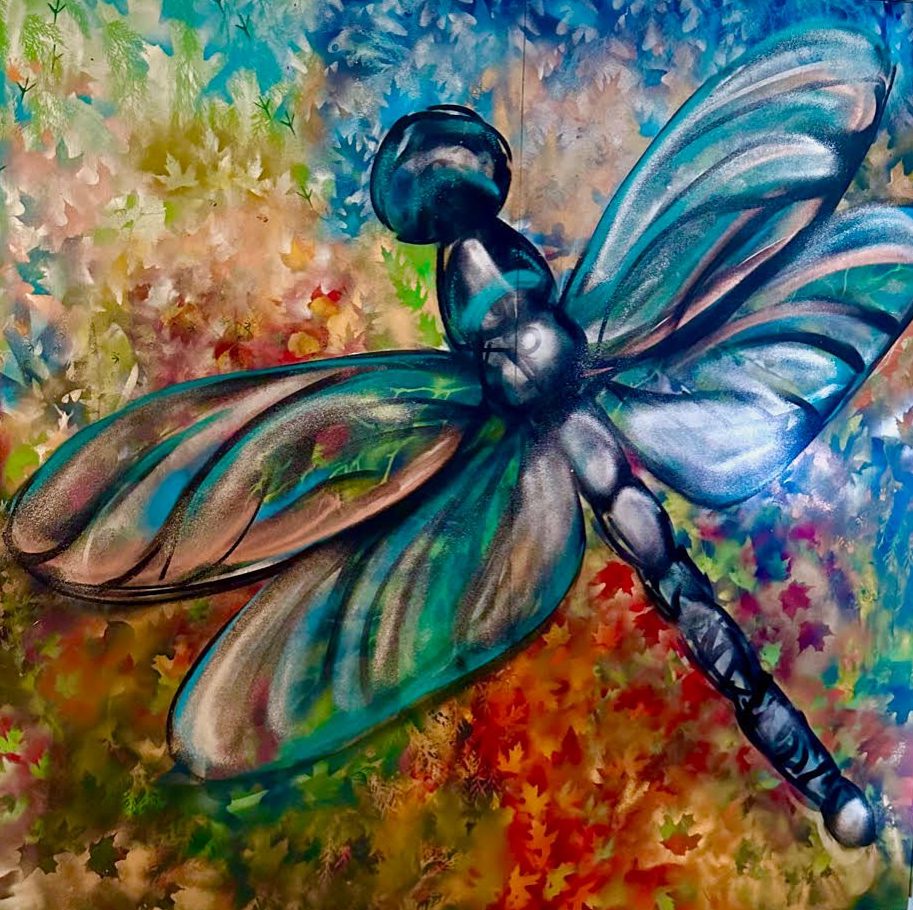
EXAR Studios in London, Ontario, built two interactive art installations in the shape of dragonflies — a metaphor and mascot for our project — that held video, images and audio from up and down the river.
We continued to add to the dragonflies as they visited senior centres, museums, libraries, festivals, markets and schools. The stories we collected became a record of the river, with the dragonflies serving as ambassadors, a magnet and a legacy project, capturing moments across different times.
They provided a unique entrance into the stories of the river for people from local, national and international communities who arrived to bear witness.
What Have We Been Up To?
We invite you to watch a short video that shares the places, stories and people that have been involved in The Voice of the River: Grand Community Play Project.
Project Brief
Project Brief: The Grand River Community Play Project: The Voice of the River was an interdisciplinary piece that connected the communities and inhabitants living along the length of the Grand River — a river that starts in the highlands of Dufferin County and travels 310 km before emptying into Lake Erie at Port Maitland. About a million people live within the watershed, which passes cities, towns and villages, trees, wild grasses and coyotes, and includes thirty-nine municipalities and two First Nations territories.
The Voice of the River was about community and meaningful connections to Indigenous leaders and communities along the Grand River. It was an inclusive creative activity involving artists, municipal and Indigenous leaders, scientists, Elders, community folk, children, not-for-profit organizations, educational institutions — and, most importantly, the Grand River.
This was a project about storytelling in all the ways stories can be told: through spoken word, song, dance, ceremony, art installations, silence, different cultural lenses and technology. It was imagined as an environmental experience — something that would develop and build over time, leading toward a unique presentation in all four seasons and over many years, passing the experience along to future generations for them to reimagine and inhabit with their own stories.
The CCRC is a unique rural centre that continually explores, in collaboration with others, what it means to be rural and how we can participate more fully.
This project expressed two of the CCRC’s core pillars:
Pillar #1
The CCRC strives to advance the needs and promote the interests of rural or remotely located communities.
The Grand River Community Play Project: The Voice of the River connected the CCRC to a new rural constituency along the length of this Heritage River. By bringing people together from different communities, promoting each community as a participant in the project, and bringing together people who might never otherwise have met, stories were told, ideas flourished and actions took place to regenerate their homes, their communities and their relationships with each other.
In the process, the project brought folks into the CCRC fold from rural communities that had not known about us before.
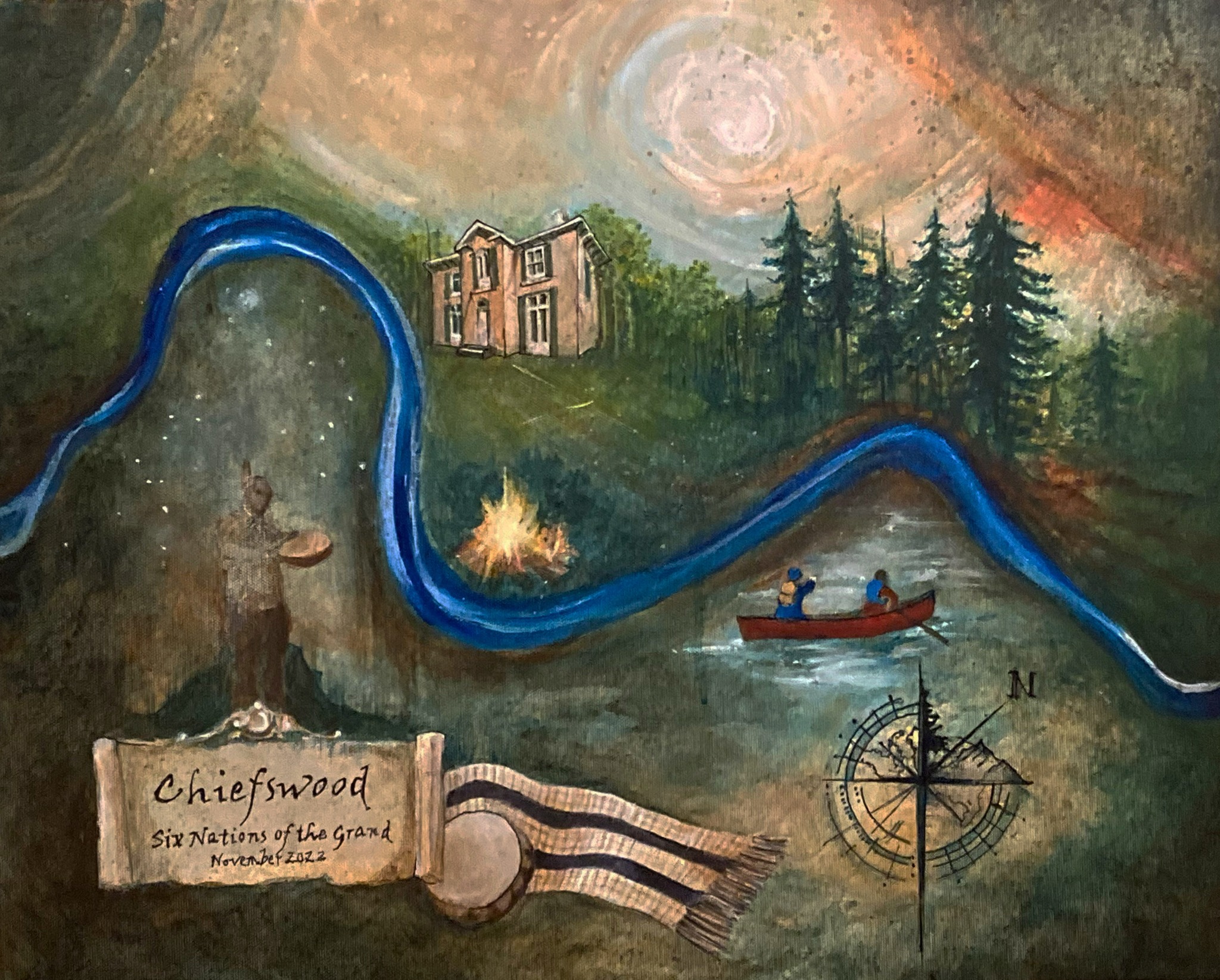
Painter: Pat Flood
Pillar #2
By facilitating research, disseminating information to the public and providing educational and networking opportunities to the public.
The Grand River Community Play Project: The Voice of the River created a rural network connecting people along the length of the river with each other and with those connected to the CCRC. By coming together in creativity with a purpose to tell their stories, people opened their eyes and hearts to learn more about where they lived and who their neighbours were.
The project brought together a number of learning centres, including Laurier, the University of Waterloo, the University of Guelph and Six Nations Polytechnic. It became a research project in regenerative tourism, mapping and storytelling, and rural economic and social development. That information was being shared with people along the waterway, with plans to eventually make it available to a much broader community.
Through our work with the learning centres, a younger demographic came forward: students from different programs came aboard to participate in technical work, performance and research.
Get Involved
Curious about this project, have a Grand River story to tell, or would like to become more involved? Contact Peter Smith.
What Is a Community Play?
It begins with a conversation and builds towards a unique theatrical experience. The contemporary community play movement got started in 1979 with a play produced by the Colway Theatre Trust. The company went on to produce over 50 productions worldwide and spawned collectives that created their own community play projects.
The process is transformative. Through the months leading up to a production, there are more conversations, meetings, workshops and rehearsals, and friendships develop. The result is that people feel connected to each other and to their shared sense of place. It is inclusive, and anyone and everyone can participate.
Whether someone participates as an actor, manager, designer, researcher, writer, builder, musician, dancer or technician, the production is community-led. The two-year process of creating the play develops the thinking, talents and skills of all involved and weaves them together. It is a community game-changer.
Project Legacy
This was an inclusive project that brought artists and communities together — something intended to evolve as the communities continued to evolve. It brought together people who might never otherwise have come together and involved them in a creative, transformational experience. It was a celebration, a holler, something that left the campsite better than it was found. It brought people to the area who knew nothing about the river.
By bringing people together in creativity and celebration, a mutual dependence began to grow, and in that environment, ideas flourished. We began to see each other anew, and a deeper understanding emerged that the Grand River is a relation of ours, a community member who deserves our respect.
To restore any place, we must also begin to re-story it, to make it the lesson of our legends, festivals, and seasonal rites. Story is the way we encode deep-seated values within our culture. Ritual is the way we enact them. We must ritually plant the cottonwood and willow poles in winter in order to share the sounds of the vermillion flycatcher during the rites of spring. By replenishing the land with our stories, we let the wild voices around us guide the restoration we do. The stories will outlast us.
— Gary Paul Nabhan
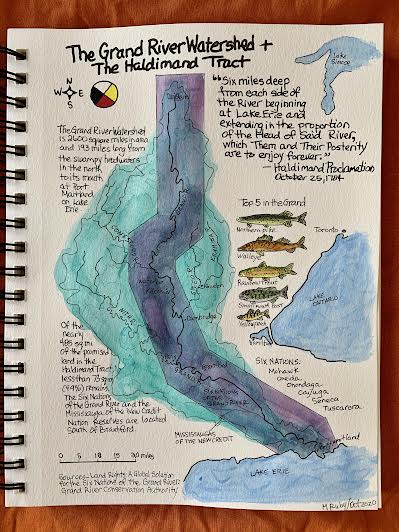
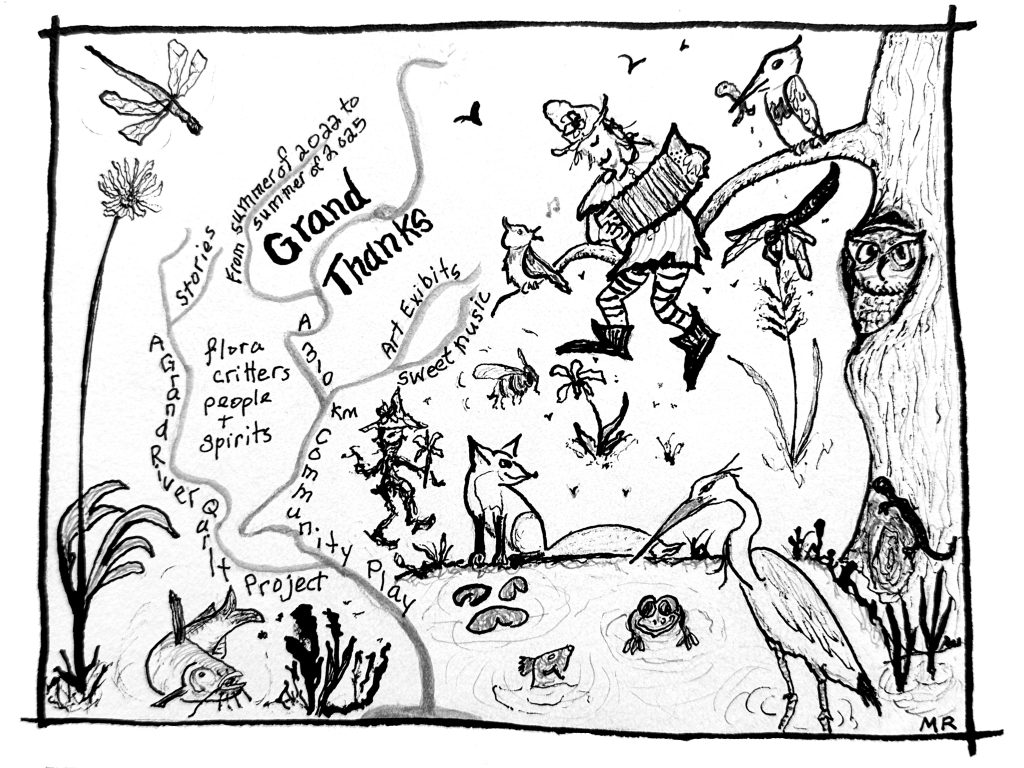
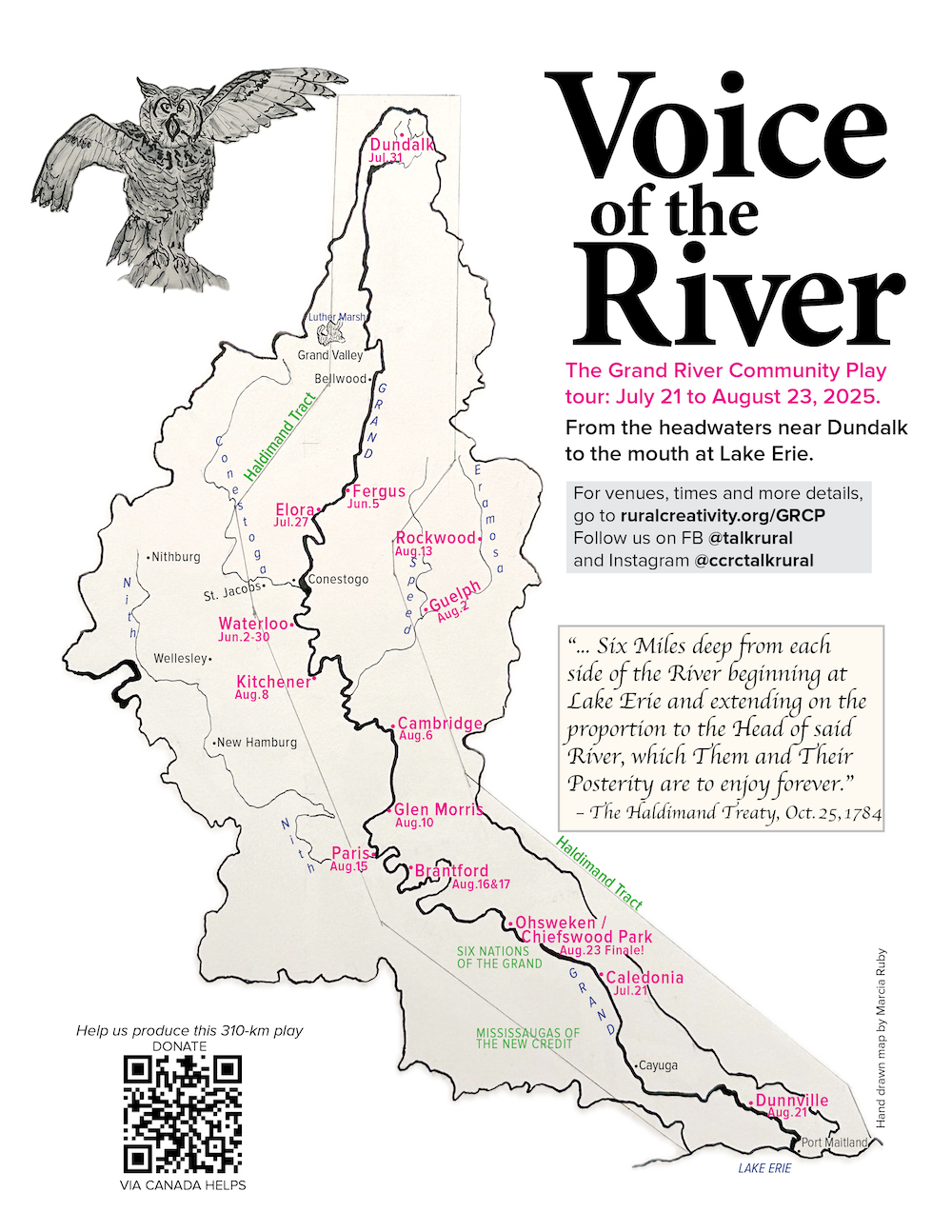
Map by Marcia Ruby
This map was created by our friend, Marcia Ruby. What she wrote in the margins was grist for the mill in the creation of this project. The Indigenous story of the Grand River, one that intersects with the Settler story now and again, runs very much independently of it. There is much to learn, and over time, with humility and respect, we hope to learn from the First Peoples who live along the Grand and have done so for millennia.
There are the more recent stories of the Settlers — those who live on the river or have been impacted by it — and these stories were also intended to be part of the project. And there is a third story, I believe — the story of the river herself. How is that story told? Can we hear the voice of the river? What can she tell us?
The following piece of writing comes from Peter Godfrey-Smith’s article entitled Other Minds: The Octopus, the Sea and the Deep Origins of Consciousness.
While a little different from hearing the voice of a river, there is something in what he says that speaks to the awe of being and could offer a way forward for the project:
“Octopuses and their relatives (cuttlefish and squid) represent an island of mental complexity in the sea of invertebrate animals. Since my first encounters with these creatures about a decade ago, I have been intrigued by the powerful sense of engagement that is possible when interacting with them. Our most recent common ancestor is so distant—more than twice as ancient as the first dinosaurs—that they represent an entirely independent experiment in the evolution of large brains and complex behaviour. If we can connect with them as sentient beings, it is not because of a shared history, not because of kinship, but because evolution built minds twice over. They are probably the closest we will come to meeting an intelligent alien.”
— Peter Godfrey-Smith
Is there a way to understand a river in somewhat the same way? Different — but, in being open to the relationship, is a different understanding possible?